
Lean Black Belt:
Transform Your Organisation. Become A Change Champion.
Lean Black Belt Training Overview
- Accredited by UL
- €4500 per person
-
Skillnet Funding Available
for eligibel companies
- In Person
- 6 Months (6 x 2 day sessions)
- In-house Project
Develop Lean, Digital & Strategic Leadership Skills
Black Belt Course Overview
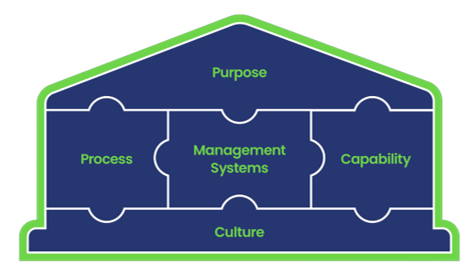
Each of the 6 training sessions are run across 2 consecutive days. Each session aligns with elements of the Transformation Framework. These training days, along with the assignments and project, will provide you with the tools and knowledge to become the transformation champion in your organisation.
1 Strategic Direction & Lean Thinking
The first day of the training introduces the LBS Transformation Framework. Here you will learn about the elements that must be in place to ensure an organisation can successfully embed Lean and Digital Thinking.
Key learnings
- Introduction to Purpose, Process, Culture, Capability and Management Systems.
- How to develop a Lean Transformation Pathway & define the Purpose.
- Hoshin Planning (Kanri).
- Objectives and Key Results.
The second day focuses on the evolution of Lean Thinking. Here you will gain knowledge of the core Lean Principles. Learnings are embedded through an interactive lean simulation. You will also be introduced tothe topic of Value Stream Mapping.
Key Learnings
- The mindset needed to apply Lean Thinking in the Digital environment.
- The application of Lean Thinking to transform your business.
- How the Lean Principles together can help to shape your “Lean Enterprise“.
- Value Stream Map construction to ensure fulfillment of customer requirements.
2 Problem Solving & Cultural Leadership
The third day introduces the DMAIC framework and A3 Methodology which are two of the key elements in problem solving. This will build the process skill, supporting the organisation’s purpose.
Key Learnings
- The role of structured problem-solving in business transformation.
- Leading a problem-solving culture.
- A deep-dive into
- Problem-Solving Methodologies
- Project Management
- A3 thinking
The fourth day will cover the fundamentals of leadership. Leadership is a critical part of every organisationon their path to operational excellence.
Key Learnings
- How leadership is defined.
- Overview of the different types and styles of leadership.
- The roles and responsibilities of a leader.
- Developing and providing vision.
3 Digitalisation & Management Systems
The fifth day explores digitalisation, data, and AI: examining how technology transforms organisational performance.Through discussion and practical exercises, participants will connect digital tools, system implementation, and AI concepts to real-world business challenges.
Key Learnings
- Understanding what digitalisation means for individuals and organisations.
- Identifying digital requirements and linking them to data-driven decision-making.
- Exploring how AI can be applied effectively in business operations.
- Managing software system implementations using project management principles.
The sixth day introduces the topic of S&OP. S&OP connects strategy to execution, helping businesses operate more efficiently, profitably, and responsively. Later in the day we will explore the relationship between ISO Standards and Lean Methodologies.
Key Learnings
- Create proactive Sales & Operations Plans (S&OP), uniting teams.
- How to develop an Integrated Business Planning process.
- Common ISO Standards.
- Key ISO Principles & Benefits.
- PDCA Cycle.
- ISO and Lean Thinking.
4 Management Systems & Capability
During the seventh day of the training attendees will take part in a site visit. During the site visit trainees will observe how using visual tools can make work status, performance, and problems obvious to everyone at a glance.
Key Learnings
- How visual management can build the right behaviors.
- How to develop and deploy a 6S programme.
- The concept of Tiered PIT, the various tiers and how they interact with each other.
The eighth day of training covers the topic of Teams. High performing teams are essential as they combine diverse skills, ideas, and perspectives to solve problems, improve processes, and drive continuous improvement
Key Learnings
- Knowledge of the fundamental attributes of a team.
- Exploring the stages involved in developing a successful team.
- How to develop and retain a high performing team.
5 Management Systems & Culture
The ninth day introduces the topics of Leader Standard Work, KATA and Manager as a Coach. These are key elements of the Transformation Framework, Leadership & Management Systems.
Key Learnings
- How Leader Standard Work promotes standardisation & drives problem-solving
- The meaning and routines associated with KATA.
- KATA and culture change.
- How a manager-coach approach can make problem-solving a habit.
The tenth day focusses on People Management. People management is the process of leading, supporting,and developing individuals within an organisation so they can perform at their best and contribute to overall business goals.
Key learnings
- Fundamentals of People Management.
- Understanding People.
- People Management Skills.
6 Change Management & Sustainability
- The fundamentals of change.
- Exploring the nature of change.
- How to successfully plan and implement change.
- Developing a change culture.
- Introduction to ESG principles and the UN Sustainable Development Goals (SDGs).
- Key regulatory requirements and understanding Scope 1, 2, and 3 emissions.
- How to develop and deliver a practical sustainability strategy.
REQUEST INFO
Enter your details below and a representative from LBS Partners will provide information tailored to your needs
Our Results Speak for Themselves
FAQ’s
Day 1
1. From Team Member to Team Leader
- Transitioning into management: mindset, relationships, and responsibilities
- Common challenges and mistakes of first-time managers
- What people expect from their manager
2. The Fundamentals of People Management
- Defining people management
- Exploring management vs leadership
- The business impact of great (and poor) managers
3. Understanding People
- Emotional intelligence and self-awareness
- Personal values, strengths, and stress triggers
- Understanding others: empathy, trust, and respect
- Building psychological safety in teams
4. Communication & Influence
- Communication styles: assertive, passive, aggressive, passive-aggressive
- Active listening and non-verbal cues
- Asking powerful, coaching-style questions
Who is the course aimed at?
Change agents or continuous improvement leads who drive or oversee improvement initiatives across their organisation. The learnings can be applied to industries including manufacturing, financial services, aviation, ICT, food & beverage and medical devices & pharmaceutical.
How much does it cost?
The baseline cost of the training is €4500. Funding of up to 50% is available for eligible companies through Skillnets. For detailed pricing and funding options, please get in touch with our team.
Where will the training take place?
The majority of the training will take place at a venue located centrally. Some sessions will take place at other venues close to where site visits take place. These details will be provided well in advance of the training
What is the time commitment?
Our Lean Black Belt Training is delivered across six two-day sessions. Each session consists of two consecutive days of training. The duration of the course is 6 months. Participants are expected to complete 40-70 hours ofself-directed hours.
What Kind of Certification Will I Receive?
You will receive a Lean Black Belt certification (Black Belt Six Sigma). This demonstrates your ability to lead and sustain Lean transformations.
The course will be accredited by University of Limerick. NQF level 9 with 6 ECTS credits
Why choose LBS Partners?
Unlike purely theoretical courses, LBS Partners Black Belt Training is practical, hands-on, and results-driven,ensuring participants can immediately apply what they learn to deliver measurable improvements in their organisations.
Who are the tutors?
Strategy Gene Leonard
Process & Lean Niall Tuite
People & leadership David Graham
Digitalisation Mark Leonard
Sustainability Grainne O’Rourke
How is digitalisation integrated into the course?
Digital skills are essential in today’s world because they enable people and organisations to function, communicate, and compete effectively in an increasingly technology-driven environment. With this in mind, we have dedicated a full day to digitalisation. We also include examples throughout the training where digitalisation can be applied to enhance lean in an organisation.
REQUEST INFO
Submit your details and a representative from LBS Partners will provide information tailored to your needs